Loading...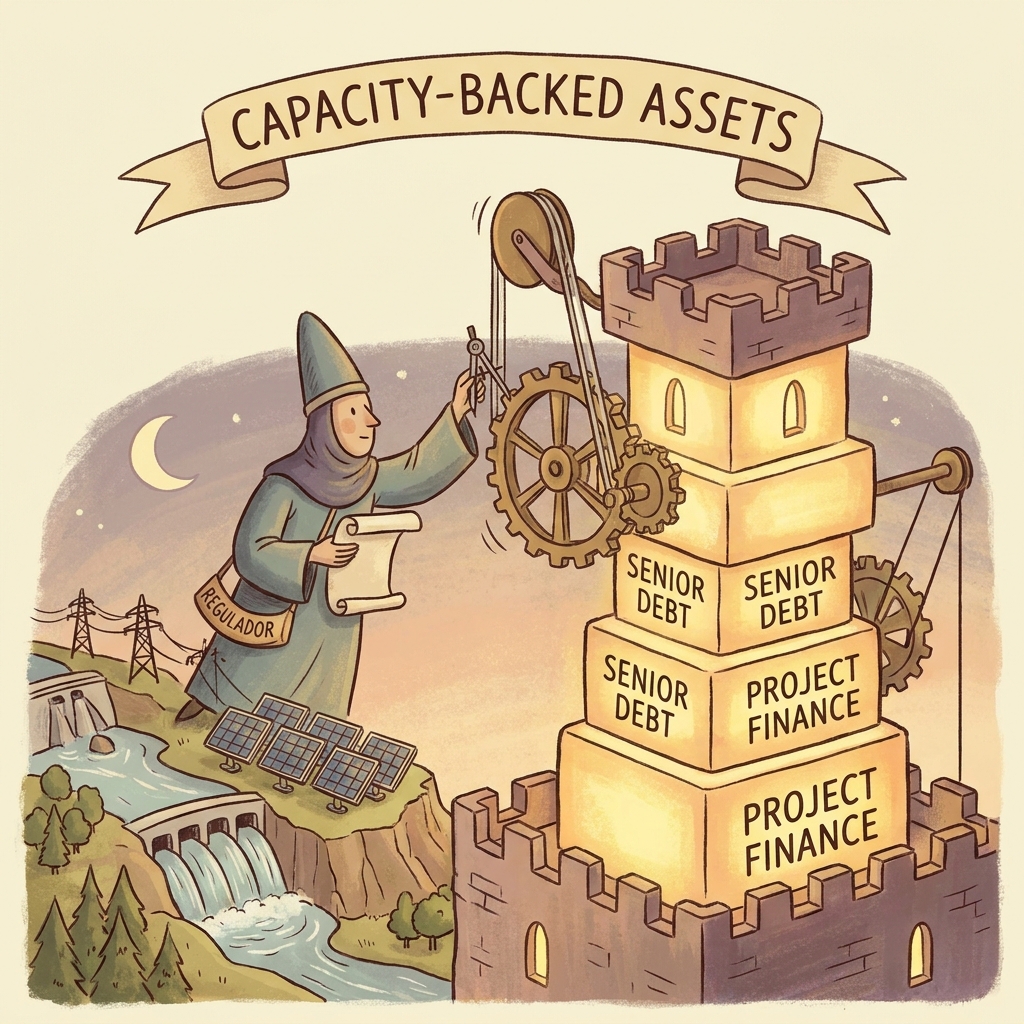
When the Federal Prosecutor's office at ANEEL formally recommended denying Âmbar Energia's administrative appeals against the Reserve Capacity Auction (LRCAP) on 28 April, the headlines framed it as a consumer-protection story. That reading is incomplete. What actually happened last week is that the Brazilian regulator quietly repriced the senior debt sitting on top of an entire class of capacity-backed project finance.[1]
This is the execution phase of a thesis I laid out on 21 April, when I argued that the LRCAP audit was a capital stack problem disguised as a regulatory one. The prosecutor's recommendation moves the conversation from "what if ANEEL enforces" to "what does the recovery curve look like when ANEEL enforces." For private equity sponsors, infrastructure debt funds, and the Brazilian banks syndicating senior tranches against LRCAP availability payments, the answer is no longer hypothetical.
From Regulatory Risk to Credit Event
The mechanics matter. LRCAP contracts are the fixed availability payments that underwrite senior debt on dispatchable capacity projects in Brazil. They are the bankable cashflow — the reason a thermal or reserve capacity asset can carry leverage at all. When the prosecutor recommends denying an appeal, two things happen simultaneously: the contract's enforceability is impaired, and any technical-default covenant tied to "material adverse regulatory determination" starts ticking.
If LRCAP contracts are voided or materially penalized, equity is wiped out before the dispute is resolved. Senior lenders — not sponsors — absorb the timing mismatch between an ANEEL board vote and any judicial injunction.
That is not a theoretical claim. Look at what Fitch did to Enel Brasil on 27 April, downgrading the utility on the risk that ANEEL terminates its São Paulo distribution concession.[5] The downgrade is a real-time, quantitative proxy for what regulatory enforcement does to a Brazilian utility capital stack: spreads widen, refinancing windows narrow, and covenant headroom evaporates — all before any final administrative ruling. Âmbar's lenders should be modeling the same trajectory now, not after the ANEEL board votes.
Why ANEEL Has the Political Cover to Push
The macro backdrop gives the regulator unusual room to maneuver. ANEEL approved a yellow tariff flag for May 2026 — the first additional consumer charge of the year — citing drought conditions and rising procurement costs.[8] In parallel, it greenlit structural tariff increases for 22 million consumers across eight distributors.[3][4]
In that political environment, a regulator cannot tolerate phantom megawatts on its capacity registry. The grid is hydro-heavy and drought-exposed; LRCAP exists precisely to secure firm, dispatchable backup. Allowing a generator to retain capacity contracts it cannot or did not deliver against would be politically untenable while consumers are absorbing yellow-flag surcharges. ANEEL's posture toward Âmbar is therefore structurally aligned with its tariff messaging — and that alignment is what makes the enforcement durable rather than negotiable.
This also rhymes with what FERC has been doing in the U.S. capacity markets, a theme I covered on 25 April. Global grid regulators are converging on a hostile-enforcement posture against capacity market participants whose paper commitments outrun their physical performance. Brazil is not an outlier; it is on-trend.
What This Means for the Capital Stack
Three implications for investors holding or underwriting Brazilian infrastructure paper:
First, senior lenders bear the real cost. Equity in LRCAP-backed SPVs is typically thin and structurally subordinated to availability-payment cashflows. When those cashflows are impaired, the equity check is gone in a single board vote. Senior debt — often syndicated across BNDES, Brazilian commercial banks, and increasingly international infrastructure debt funds — is left negotiating recovery against a counterparty whose primary asset has just been administratively devalued.
Second, secondary spreads will lead the news. Watch Brazilian utility infrastructure bond yields this week. The Enel downgrade is the public marker; private debt marks will move in sympathy across any name with LRCAP exposure or distribution concession risk. Mark-to-market funds should be pre-positioning, not reacting.
Third, replacement capacity is now an open procurement question. If Âmbar's megawatts are stripped from the registry ahead of the dry season, ANEEL needs an emergency mechanism to plug the gap. That creates opportunity — but only for sponsors whose offtake structuring, compliance posture, and capital stack are already aligned with the regulator's new expectations.
Why Early Engagement Has Become Non-Negotiable
The lesson PE sponsors should take from Âmbar is not that Brazilian capacity assets are uninvestable. It is that the diligence and structuring window has compressed dramatically. Regulatory posture, covenant architecture, and compliance documentation now need to be stress-tested before the term sheet, not after the first ANEEL letter arrives.
This is precisely where engaging P&L Energy early in a deal cycle changes outcomes. Auction compliance review, LRCAP eligibility validation, and capital stack stress-testing against ANEEL's enforcement playbook are the kind of pre-signing work that separates assets that survive 2026's regulatory regime from assets that become next quarter's Fitch downgrade. Bringing that lens in at LOI stage — rather than at refinancing or restructuring — is now the difference between a bankable thesis and a recovery exercise.
What to Watch Next
Three milestones will define the next 60 days. First, the ANEEL board's binding vote on the Âmbar appeals — the prosecutor's recommendation is not yet final, and the timeline for the board's deliberation will set the clock for any covenant triggers. Second, Enel Brasil's request for reconsideration on the São Paulo concession; a denial there would confirm that ANEEL's enforcement posture extends to top-tier counterparties.[5] Third, any emergency capacity procurement notice from ANEEL ahead of the dry season — the operational tell that Âmbar's megawatts are being formally written out of the system.
The April 21 piece was the warning. This is the execution. The post-mortem on Brazilian infrastructure debt pricing in 2026 will trace back to the last week of April, when a prosecutor's recommendation and a Fitch downgrade quietly rewrote the recovery assumptions on a generation of capacity deals.
References
- Procuradoria da ANEEL recomenda negar recursos da Âmbar ao LRCAP — Agência iNFRA, 28 Apr 2026. Link
- Aneel aprova aumento nas tarifas de oito distribuidoras — eixos, 27 Apr 2026. Link
- Aneel aprova reajuste das contas de luz de 22 milhões de clientes — UOL Economia, 27 Apr 2026. Link
- Enel contesta Aneel e pede reconsideração em processo que pode encerrar concessão em SP — Valor Econômico, 27 Apr 2026. Link
- Aneel anuncia bandeira amarela para maio — Folha de S.Paulo, 26 Apr 2026. Link