Loading...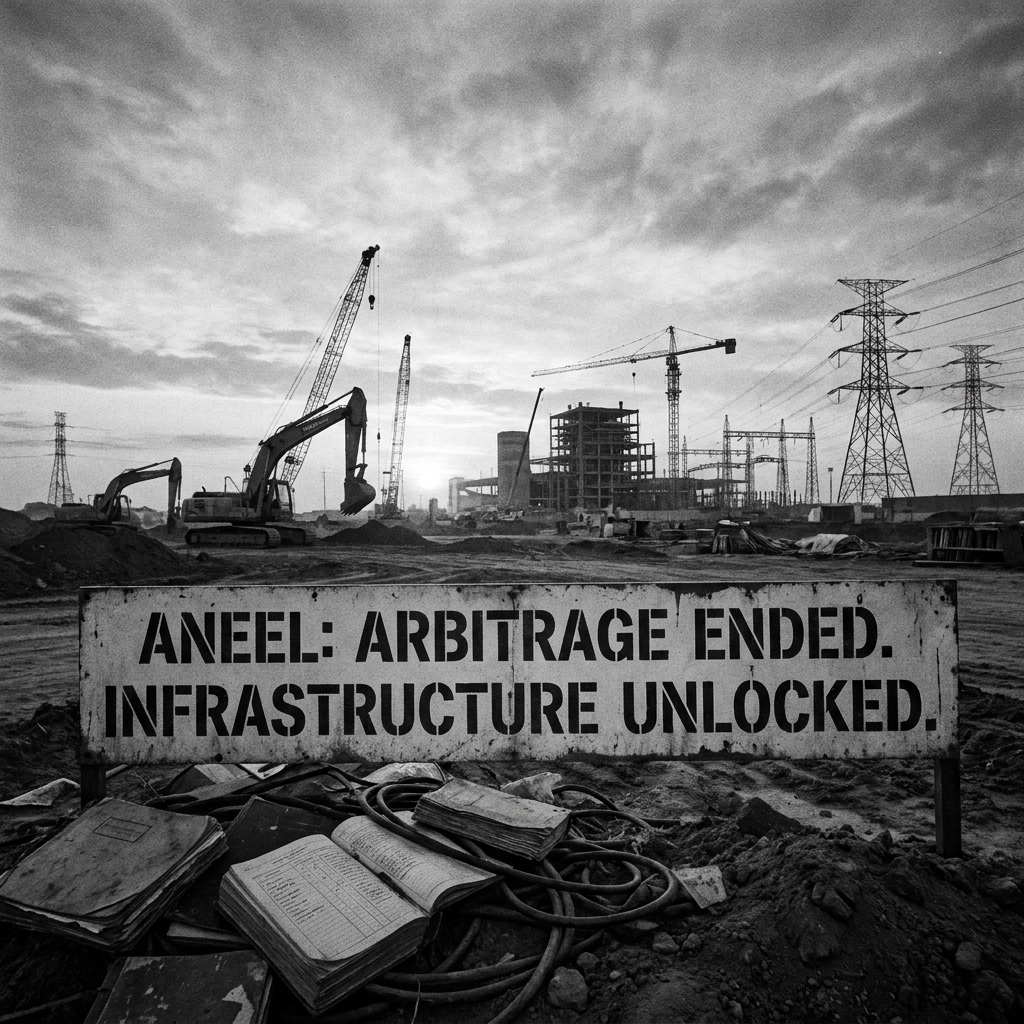
By approving 2.18 GW of firm thermal capacity while publicly declaring the death of pure price arbitrage, ANEEL is telling foreign capital that Brazil's power market is now strictly for infrastructure adults, not speculative traders.
On April 30, ANEEL formally approved—habilitou—13 thermal generating plants totaling 2.18 GW from winning sponsors in the 2026 Capacity Reserve Auction (LRCap).[1][5] Days earlier, the regulator's board denied administrative appeals from the J&F group and UEG Araucárias, two politically connected players challenging auction results that anchor a R$ 515 billion energy procurement pipeline.[4][7] And in between those two decisions, an ANEEL director went on record stating that the electricity "price arbitrage market is no longer sustainable."[9]
Read those three moves together and the signal is unmistakable: Brazil's power sector is structurally pivoting from a market that rewarded speculative energy trading to one that rewards heavy infrastructure sponsors who can guarantee grid reliability. If you've been watching this space purely for arbitrage margin, the exit door just narrowed considerably. If you build and finance real assets, the entrance just widened.
The Habilitação Is the Capital Stack Trigger
Foreign investors and international lenders sometimes underestimate the significance of habilitação in Brazilian power markets. It is the downstream regulatory milestone that converts an auction win—still essentially a conditional contract—into a bankable asset. Before habilitação, a project is a commitment on paper. After it, BNDES can release development finance tranches, international commercial banks can close project finance facilities, and EPC contractors can mobilize.
For the 13 plants approved last week, this means the capital deployment phase has formally begun. The aggregate capacity—2.18 GW of firm thermal reserve—represents a substantial tranche of dispatchable generation that Brazil needs as its renewable penetration deepens and grid reliability premiums increase.[5]
ANEEL's simultaneous approval of 13 compliant plants and rejection of non-compliant appeals is not coincidence—it is a deliberate regulatory sequencing that tells the market exactly who belongs at the table.
This is the concrete execution of the thesis I laid out in earlier pieces on ANEEL's crackdown dynamics and the LRCap audit cycle. We've moved from regulatory theory—ANEEL is getting strict—to execution reality: strictness just cleared 2.18 GW for immediate deployment.
Denying J&F Proves Institutional Independence
The rejection of J&F's appeal deserves particular attention from anyone pricing regulatory risk in Brazil. J&F is not a marginal player—it is one of Brazil's largest and most politically connected conglomerates. ANEEL's board denied both the J&F and UEG Araucárias appeals on what appear to be strict auction compliance grounds, maintaining the integrity of LRCap rules against aggressive legal challenges.[4]
For foreign capital, this is the data point that matters more than any investment-grade rating upgrade. The regulator enforced the rules against a domestic heavyweight to protect R$ 515 billion in contracted energy procurement.[7] That figure—reportedly representing lifetime PPA contract value across the auction pipeline—is the kind of number that only holds if market participants believe the contracts behind it are inviolable. ANEEL just demonstrated they are.
Pair this with the regulator's proactive outreach to economic analysts on May 1, explicitly signaling its regulatory agenda,[3] and the pattern is clear: ANEEL is managing its credibility with capital markets as deliberately as it manages grid operations.
The Tariff Signal Completes the Picture
One piece often overlooked in capacity market analysis is tariff adequacy. A regulator can approve all the generation capacity it wants, but if tariffs don't support system cost recovery, the entire capital stack is built on a fiction.
ANEEL's approval of a 4.25% average tariff increase for Neoenergia Pernambuco—with high-tension industrial users absorbing a 7.19% hike—demonstrates continued willingness to pass through real system costs despite the political friction that always accompanies rate increases in Brazil.[2][8] This is systemic solvency maintenance, and it directly backstops the revenue assumptions underpinning the 13 newly approved thermal plants.
2.18 GW approved. R$ 515 billion in pipeline protected. Price arbitrage declared unsustainable. Tariffs adjusted to cover real costs. Four signals, one message: Brazil is pricing for reliability, not speculation.
What to Watch Next
Three things matter from here. First, sponsor identification and EPC mobilization—the market needs to see who the ultimate equity backers behind these 13 plants are and whether they have the execution track record to bring 2.18 GW online on schedule. Second, BNDES financing terms—the split between domestic development bank financing and international commercial debt will reveal how lenders are pricing post-habilitação risk in the current rate environment. Third, the downstream effects on the Mercado Livre—the ANEEL director's comments about arbitrage sustainability will squeeze specific trading houses and unregulated market participants whose business models depend on price volatility rather than asset ownership.[9]
The broader takeaway is structural. Brazil's power market is entering a phase where regulatory discipline, tariff adequacy, and capacity reliability are the three legs of the investment stool. Two weeks ago, I argued that ANEEL's crackdown was inviting the adults into the room. This week, the adults got their building permits.
References
- "Aneel habilitou 13 centrais geradoras de empresas vencedoras no leilão de reserva," Acessa.com, 3 May 2026. Link
- "Aneel aprova alta média de 4,25% para consumidores da Neoenergia Pernambuco," Diário do Grande ABC, 28 Apr 2026. Link
- "ANEEL dialogou com analistas econômicos para sinalizar agenda regulatória do setor elétrico," Urbano Vitalino, 1 May 2026. Link
- "Diretoria da Aneel nega recursos da J&F e UEG Araucárias no leilão de reserva de capacidade," Reporter Diário, 1 May 2026. Link
- "Aneel habilita 2,18 GW em térmicas do LRCap 2026," MegaWhat, 1 May 2026. Link
- "Aneel habilitou 13 centrais geradoras de empresas vencedoras no leilão de reserva," UOL Economia / Estadão, 30 Apr 2026. Link
- "Aneel rejeita recursos e mantém leilão de energia de R$ 515 bi," O Tempo, 28 Apr 2026. Link
- "Aneel aprova alta média de 4,25% para consumidores da Neoenergia Pernambuco," Jornal de Brasília, 1 May 2026. Link
- "Mercado de arbitragem de preços não é mais sustentável, diz diretor da Aneel," MegaWhat, 30 Apr 2026. Link