Loading...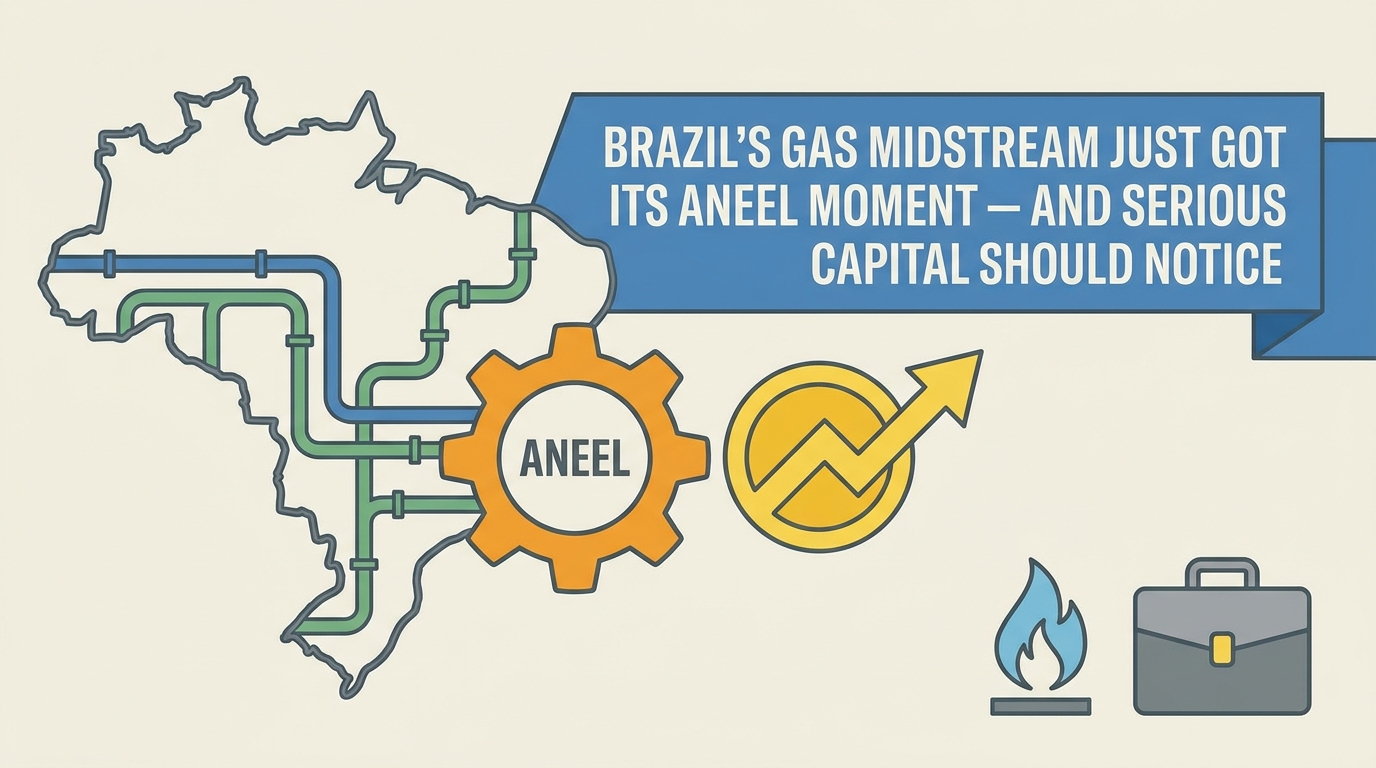
For five years, Brazil's LNG import terminals have operated as private clubs. Whoever owned the regasification asset — Petrobras, Eneva, Compass, New Fortress — effectively decided which molecules crossed the jetty. On 21 July, that ended. ANP approved the country's first framework governing third-party access to LNG terminals, and Bocater's Luiz Felipe Monteiro Seixas is right to call it a structural moment.[1] For anyone financing gas-fired power in Brazil, this is the midstream chapter of the story we've been writing all year.
The pattern we've been tracking, now extended downstream of the burner tip
Regular readers know the thesis. ANEEL denied Âmbar's LRCap appeals. It rejected Newen's force-majeure claim. It homologated the LRCap 2026 results without flinching, then ran two methodology seminars in a single week to show its work. Wärtsilä and Origem signed 371 MW of reciprocating capacity on the strength of that regulatory floor. Every one of those moves said the same thing: Brazilian power is exiting the arbitrage era and entering an infrastructure-yield era, and the regulator is the one flipping the switch.
What was missing from that story was the gas itself. A capacity auction is only as bankable as the fuel behind it. And until this week, the fuel side of the equation — specifically, the LNG import optionality that any non-Petrobras IPP relies on — sat behind a locked gate. ANP just handed out keys.
Why the terminal-access rules matter more than the headline suggests
The 2021 New Gas Law (Lei 14.134) promised open access to essential midstream infrastructure. Five years later, the operational rulebook for LNG terminals finally exists. Seixas, writing for Bocater, frames the approval as the first serious operationalization of that promise — the moment the statute stops being aspirational and starts being biddable.[1]
The practical implications are concrete:
An independent shipper — a merchant importer, a trading house, an IPP with a gas-fired plant and no captive upstream — can now, in principle, contract capacity at an existing FSRU or onshore terminal and land its own cargo. That optionality did not exist in a bankable form last Friday.
For lenders modeling a thermoelectric project, that changes the fuel-supply section of the credit memo. It moves LNG from "sole-source molecule delivered on Petrobras's opportunistic spot terms" to "contestable input with regulated recourse." That is precisely the kind of shift ANEEL forced on the power side when it stopped tolerating speculative outorgas. The upstream analog to filtering out speculators is filtering out gatekeepers.
The Senate's Amazon TPP bill only works if this framework works
The timing is not coincidental. On the same day the ANP rules landed, a Senate proposal advanced to auction new gas-fired thermoelectric plants in the Northern (Amazon) region.[2] ONS's PEN 2026 already flags a potential supply deficit from 2027, even with the 19 GW contracted at LRCap in March. The system needs dispatchable capacity, and the Senate wants gas in the North to deliver it.
Northern gas-fired auction winners will not have a Rota 3 pipeline conveniently at their doorstep. They will need molecules moved by ship and regasified at contested terminals. Without contestable terminal access, an Amazon TPP auction is a fuel-supply gamble dressed up as a capacity auction. With it, the auction becomes a real financial exercise. ANP just made the Senate's bill economically coherent.
The tightness backdrop makes this more urgent, not less
There is a temptation to read open access as a fair-weather reform — nice to have when LNG is cheap and abundant. The opposite is true. Equinor's May guidance, reflecting the Strait of Hormuz disruption, pushed the anticipated 2026–27 LNG glut out by roughly two years. Markets stay tight through 2028. LatAm buyers now face materially higher spot exposure than the models assumed six months ago.
In a tight market, terminal gatekeeping is not a nuisance — it is a solvency risk for anyone whose PPA obligations depend on someone else's cargo decisions. Open access lets new entrants pool volumes, hedge Atlantic Basin sourcing, and diversify away from Petrobras's spot-desk mood. It is the plumbing that lets the post-arbitrage thesis actually deliver molecules to the turbine.
What still needs answering — and what serious capital should do about it
Seixas and the market will spend the next quarter working through the details: whether tariffs are regulated, negotiated, or hybrid; how capacity-release mechanics filter to independent shippers; whether Petrobras's Bahia and Guanabara terminals, Eneva's CELSE complex in Sergipe, Compass's TRSP and New Fortress's Barcarena face the same obligations or partial grandfathering; and how cargo-delay and terminal-outage risk gets allocated between shipper and operator — a live question after ANEEL's tough Newen ruling on force majeure.
None of those open questions should distract from the direction of travel. ANP is following ANEEL's playbook: publish the rule, defend the rule, and let the market reprice around institutional credibility. That is the same institutional-maturation signal that moved the Wärtsilä-Origem deal from concept to signed contract, and the same signal foreign underwriters have been quietly using to nudge Brazil up the sovereign ladder.
Gas-to-power in Brazil is no longer a bet on regulatory forbearance. It is becoming a bet on infrastructure yield backed by an increasingly grown-up rulebook. The midstream just joined the adults' table.
For IPPs, EPCs, OEMs, and infrastructure funds sizing Brazilian gas-fired opportunities, the practical next step is to re-open the fuel-supply annex of every model built before 21 July. Terminal optionality is now a real line item. Price it accordingly.
Stay with the story
We'll be tracking the ANP resolution's implementation, the Northern TPP auction design, and the incumbents' response in detail over the coming weeks. Subscribe to our newsletter to get each installment — plainly written, capital-stack first, and built for the decisions you actually have to make.
References
- "Luiz Felipe Monteiro Seixa discusses the approval of the first regulations governing access to LNG terminals in Brazil," Bocater, 21 Jul 2026. Link
- "Proposta que prevê novas termelétricas movidas a gás natural da Amazônia avança no Senado," Folha BV, 21 Jul 2026. Link
- "Redrawing the Map: How Iranian Routing Vulnerabilities Force a Restructuring of LatAm LNG Import Deals" (Equinor guidance, May 2026), P&L Energy internal synthesis.
- "Daily headlines: EDP's US$2bn Brazil grid plan," BNamericas, 21 Jul 2026. Link