Loading...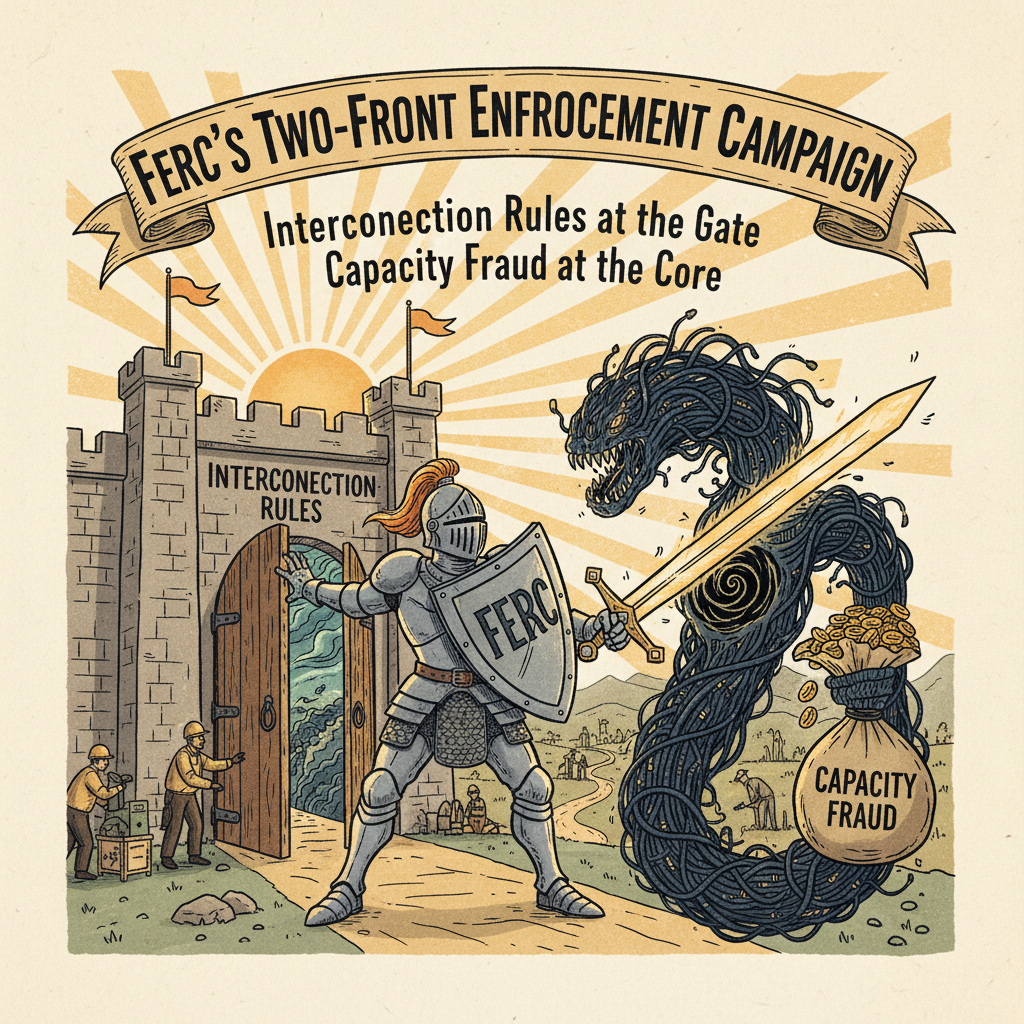
Two weeks ago I wrote about FERC rewriting grid access rules — tightening interconnection queue standards, reshaping load-serving entity obligations, and forcing a rethink of on-site generation strategy for data center developers and large C&I offtakers. That piece framed FERC as a Commission in active, precedent-setting mode. The $1.1 billion civil penalty issued this week against demand-response aggregator American Efficient LLC confirms the other half of that story: FERC isn't only building new rules at the point of grid entry. It is enforcing hard consequences at the point of grid obligation.[1] Taken together, these two regulatory moves define a two-front campaign that every developer, buyer, and financier working in PPA and demand-response structures needs to understand before 2026 capacity commitments crystallize.
What American Efficient Actually Did — and Why the Mechanics Matter
American Efficient operated as a demand-response aggregator in PJM Interconnection's capacity market, known as the Reliability Pricing Model (RPM). In that role, it bid curtailable load — commercial and industrial customers committed to reducing consumption on demand — into PJM's Base Residual Auction (BRA) as capacity resources. Capacity market participation is not incidental: winning a capacity auction means receiving capacity payments in exchange for a firm performance commitment during grid stress events.
FERC's Office of Enforcement alleges that American Efficient misrepresented the availability and performance of those demand-response resources. The core fraud claim is that resources were bid into auctions — and collected capacity revenues — that could not or did not perform as committed. The specific measurement and verification failures underlying the allegations have not been fully detailed in public filings available at press time, and readers should confirm docket specifics via FERC's eLibrary as the IN-series proceeding develops. But the structural point is clear: American Efficient reportedly collected capacity revenues against obligations its resource base could not reliably support.
PJM's BRA clearing price for the 2025/2026 delivery year reached approximately $269.92/MW-day for most of the RTO zone — up from sub-$50/MW-day in the 2022/2023 delivery years. A roughly 5–6x increase in capacity prices means a roughly 5–6x increase in the financial return from inflating DR bids, and a correspondingly larger disgorgement base for FERC's penalty calculus.
That pricing context explains the penalty magnitude. At $1.1 billion, this dwarfs every prior FERC civil penalty in recent memory — the Constellation/Exelon action in 2013 settled near $34.9 million; the Powhatan Energy Fund matter involved a $30 million proposed penalty; EDF Trading's early DR misrepresentation case resolved around $4.5 million.[1] American Efficient is an order of magnitude larger than all of them. FERC's enforcement math scales with ill-gotten revenues, and in a market that cleared at nearly $270/MW-day, the ill-gotten revenues were substantial.
The Compliance Gap Demand-Response Aggregators Have Always Carried
Physical generation assets face NERC reliability standards, continuous telemetry, and physical output metering. When a generator fails to perform, the evidence is real-time and unambiguous. Demand-response aggregators operate in structurally different compliance territory. Their performance depends on customer-side measurement and verification (M&V) protocols, third-party enrollment data accuracy, curtailment confirmation systems, and the actual behavioral response of enrolled end-users during a dispatch event. The audit surface is wider, the data is softer, and the verification chain runs through multiple parties — the aggregator, the curtailment service provider, the metered customer, and the ISO's settlement system.
FERC's Office of Enforcement has now applied the same fraud standard to a DR aggregator that it has historically reserved for physical market participants and energy traders. That is a meaningful precedent shift. Firms operating in structurally similar positions — including large national DR platforms serving C&I customers across PJM and other ISOs — should treat the American Efficient case as a live compliance benchmark, not a one-off enforcement outlier.
Where PPA Counterparties Carry Hidden Exposure
The American Efficient penalty is not only a story about one aggregator. It is a story about how capacity market compliance risk travels through commercial agreements. Many C&I PPAs executed over the past three years include demand-flexibility riders, load-curtailment commitments, or capacity tag pass-through provisions — ICAP and UCAP structures that link the buyer's contractual obligations to capacity market participation by a third-party aggregator or curtailment service provider.
If the underlying DR aggregator is misrepresenting performance, the PPA counterparty — the offtaker — may face secondary exposure depending on how the agreement allocates capacity market compliance risk. Depending on contract language, that exposure could manifest as credit support calls triggered by aggregator default, termination events tied to regulatory disqualification of enrolled DR resources, or direct liability if the offtaker is named as a beneficiary of fraudulent capacity revenues. Project finance lenders with security interests in capacity revenue streams face a parallel diligence question: what compliance representations did the borrower obtain from its DR aggregator, and are those representations independently verifiable?
This is the practical enforcement ripple. FERC's $1.1 billion order against American Efficient does not stay inside American Efficient's corporate structure. It surfaces in every agreement downstream that assumed clean capacity market participation.
The Two-Front Picture — and What to Watch in 2026
Read alongside the April 22 interconnection rulemaking piece, the American Efficient penalty completes a regulatory frame that has been building across this Commission's tenure. FERC is tightening rules at the point of grid entry through interconnection queue reform and data center load accountability standards. It is simultaneously enforcing hard consequences at the point of grid obligation through capacity market fraud prosecution. The rulemaking arm and the enforcement arm are moving in the same direction and accelerating on parallel tracks.
For developers and buyers building integrated PPA and DR strategy into 2026, that dual pressure has concrete implications. Grid access is harder to obtain under tighter interconnection standards. Capacity commitments are under more aggressive enforcement scrutiny. The margin for structural ambiguity — in aggregator enrollment data, in M&V methodology, in PPA compliance allocation language — has narrowed materially.
It is worth noting that this enforcement pressure is not unique to U.S. markets. Brazil's ANEEL has been imposing nine-figure compensation obligations on distribution companies for outage performance failures — a parallel signal that regulators globally are applying financial consequences to demand-side and distributed asset performance at a scale the market has not previously priced. For those tracking the Brazilian distributed cogeneration opportunity I outlined earlier this week, that regulatory direction matters for how performance commitments in those structures should be drafted and backstopped.
The immediate milestones to track: the development of FERC's IN-series docket on American Efficient through eLibrary, any interlocutory filings or settlement signals from the respondent, PJM's BRA results for the 2026/2027 delivery year and any DR participation rule adjustments the ISO implements in response to this enforcement action, and FERC Commissioner statements on enforcement posture in capacity markets at the upcoming open meetings. The $1.1 billion number will attract attention. The compliance framework it validates will matter longer.
References
- "FERC Orders American Efficient to Pay $1.1 Billion for Alleged Capacity Market Fraud," Troutman Pepper Locke, published via JDSupra, April 24, 2026. https://jdsupra.com/legalnews/ferc-orders-american-efficient-to-pay-1-7783841
- Philip, "FERC at the Edge of Precedent — What Data Center Interconnection Rulemaking Means for PPA Structures, Grid Access, and On-Site Generation Strategy," April 22, 2026. /digital_faith/news/3215952
- Philip, "Why Brazil Is the Right Market at the Right Time for Distributed Cogeneration," April 24, 2026. /digital_faith/news/3215957
- ANEEL — Agência Nacional de Energia Elétrica, official regulatory notices, April 25, 2026. https://www.gov.br/aneel/pt-br