Loading...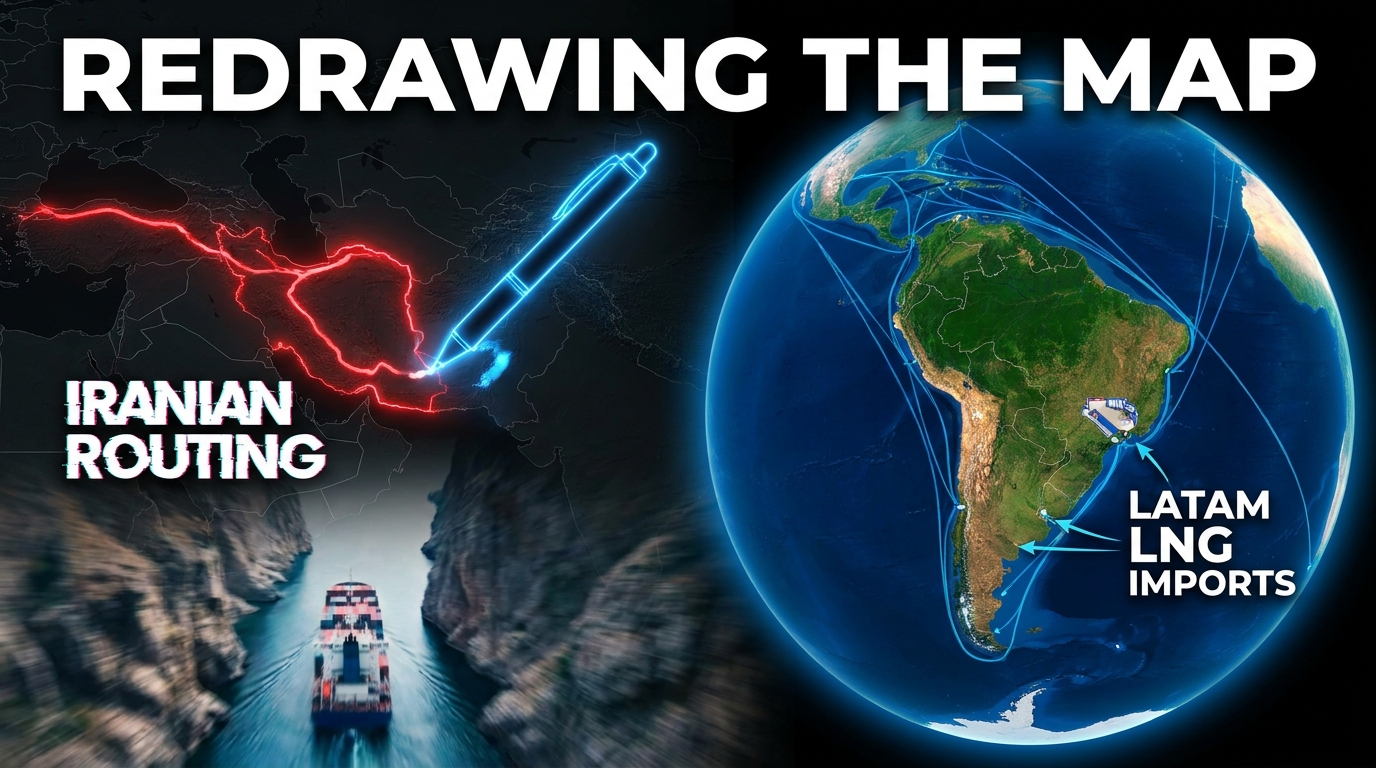
May 2026
On May 20, Equinor's commodity trading division projected that conflict with Iran and sustained disruption at the Strait of Hormuz will delay the widely anticipated global LNG supply glut by a full two years, keeping markets exceptionally tight through 2028.[1] Within 24 hours, Iran's newly established "Persian Gulf Authority" expanded its maritime claims toward UAE port infrastructure and floated the prospect of permanent transit levies on Hormuz traffic.[9] For Latin American LNG buyers—many of whom built their import strategies around the assumption of cheap, abundant spot cargoes arriving by mid-decade—the implications are immediate and structural. The question is no longer whether deal terms will change, but how fast legal and commercial teams can repaper risk allocation in a market that just lost its pricing anchor.
The Glut That Isn't Coming: Repricing Two Years of Spot Exposure
Latin America's LNG import model, particularly in Brazil, has long been built on opportunistic spot procurement. Petrobras, Eneva, and Compass Gás e Energia feed FSRUs during low-hydro seasons by competing for uncommitted cargoes on the global market. The working assumption across the region's gas-to-power sector was that a wave of new liquefaction capacity—principally from the U.S. Gulf Coast and Qatar's North Field expansion—would create a buyer's market by 2026 or 2027, compressing delivered spot prices and improving Brazilian thermal dispatch economics.
Equinor's revised timeline dismantles that thesis.[1] With roughly 20% of global LNG supply transiting Hormuz—overwhelmingly Qatari origin—any sustained disruption or toll regime removes the marginal volumes that were supposed to tip the market into oversupply. Latin American buyers now face 24 additional months competing head-to-head with European and Asian importers for a constrained cargo pool, at price levels inflated further by diesel baselines the U.S. EIA projects at $5.36 per gallon for 2026.[4]
The expected 2026–2027 LNG surplus has effectively been erased. For LatAm buyers still holding uncontracted FSRU capacity, the cost of spot exposure just increased by an order of magnitude in risk terms.
Force Majeure, Chokepoint Tolls, and the New SPA Architecture
The Hormuz crisis does not merely raise prices—it fundamentally alters how LNG Sales and Purchase Agreements must allocate risk. Three specific contract mechanics are under pressure.
Force Majeure clauses in legacy SPAs were typically drafted around facility-level events: hurricanes, equipment failures, labor disputes. A permanent Iranian toll on Hormuz traffic, or the threat of interdiction by the Persian Gulf Authority,[9] creates a novel category of chronic geopolitical risk that does not fit neatly into conventional FM definitions. Legal teams are now grappling with whether a state-imposed transit levy constitutes force majeure or simply a cost escalation—a distinction with enormous financial consequences for both sellers and buyers.
Delivery basis risk splits differently depending on contract structure. Under DES (Delivered Ex-Ship) terms, the seller bears routing risk and any Hormuz toll would fall on the supplier's margin. Under FOB (Free on Board) terms, the buyer arranges shipping and absorbs chokepoint costs directly. Expect LatAm buyers to push aggressively for DES terms from Atlantic Basin sellers, while FOB contracts from Middle Eastern origin will require explicit toll pass-through mechanisms or origin guarantees excluding Hormuz-transiting supply.
Pricing formulas indexed to JKM or TTF benchmarks may no longer reflect the actual delivered cost to South American terminals if those benchmarks are driven by Asian or European panic buying for the same constrained cargoes. New SPAs will likely feature hybrid indexation or Atlantic Basin-specific pricing corridors tied to Henry Hub plus a geopolitically adjusted shipping differential.
The Atlantic Basin Premium and the FERC Bottleneck
U.S. Gulf Coast LNG is the clear beneficiary. Geographic proximity to Brazilian and Argentine FSRUs, combined with zero chokepoint exposure, makes Gulf Coast supply the premier secure asset for Latin American procurement. But access is constrained. Projects like Venture Global's CP2 LNG (FERC Docket CP22-21-000) and NextDecade's Rio Grande LNG are navigating regulatory queues, and DOE non-FTA export license timelines directly limit the uncommitted volumes available for South American offtake over the next 24 months.
Simultaneously, the capital flight from chokepoint-exposed basins is accelerating. BP's acquisition of three new exploration blocks near Tangguh in Indonesia[5] and the Equinor–Aker BP asset swap consolidating Norwegian Continental Shelf positions[2][3] both signal supermajor capital rotating toward geographically secure production basins. For LatAm buyers, the implication is clear: the competition for Atlantic Basin offtake agreements will intensify before new capacity arrives.
Ironically, the same Equinor warning of a two-year glut delay is leading development of Brazil's BM-C-33 offshore gas project—a domestic hedge against the very import vulnerability its analysts are flagging.
What to Watch Next
Three developments will determine how quickly LatAm deal structures adapt. First, monitor Brazil's CNPE and Petrobras for any acceleration of the "Gas para Empregar" program or the Rota 3 pre-salt gas pipeline—a domestic production push is the most durable hedge against import volatility. Second, track FERC and DOE proceedings on Gulf Coast export capacity: every month of licensing delay tightens the available cargo pool for non-FTA destination buyers. Third, watch the contract renewal cycle. A meaningful share of existing LatAm LNG SPAs expires between 2026 and 2028; each renewal is now a repricing event that will embed Hormuz risk into baseline deal economics for the next decade.
The map has been redrawn. The commercial terms must follow.
References
- "Iran war pushes back LNG supply glut by two years: Equinor," Montel News, 20 May 2026. Link
- "Equinor and Aker BP strike NCS asset deal to boost offshore development," World Oil, 21 May 2026. Link
- "Equinor, Aker BP aim to optimize Norwegian Shelf interests through asset swaps," Oil & Gas Journal, 21 May 2026. Link
- "USA EIA Reveals Latest USA Diesel Price Forecast for 2026," Rigzone, 21 May 2026. Link
- "BP Enters 3 New Indonesian Blocks," Rigzone, 21 May 2026. Link
- "Iran's new Persian Gulf Authority draws lines of control around Strait of Hormuz," Upstream Online, 21 May 2026. Link