Loading...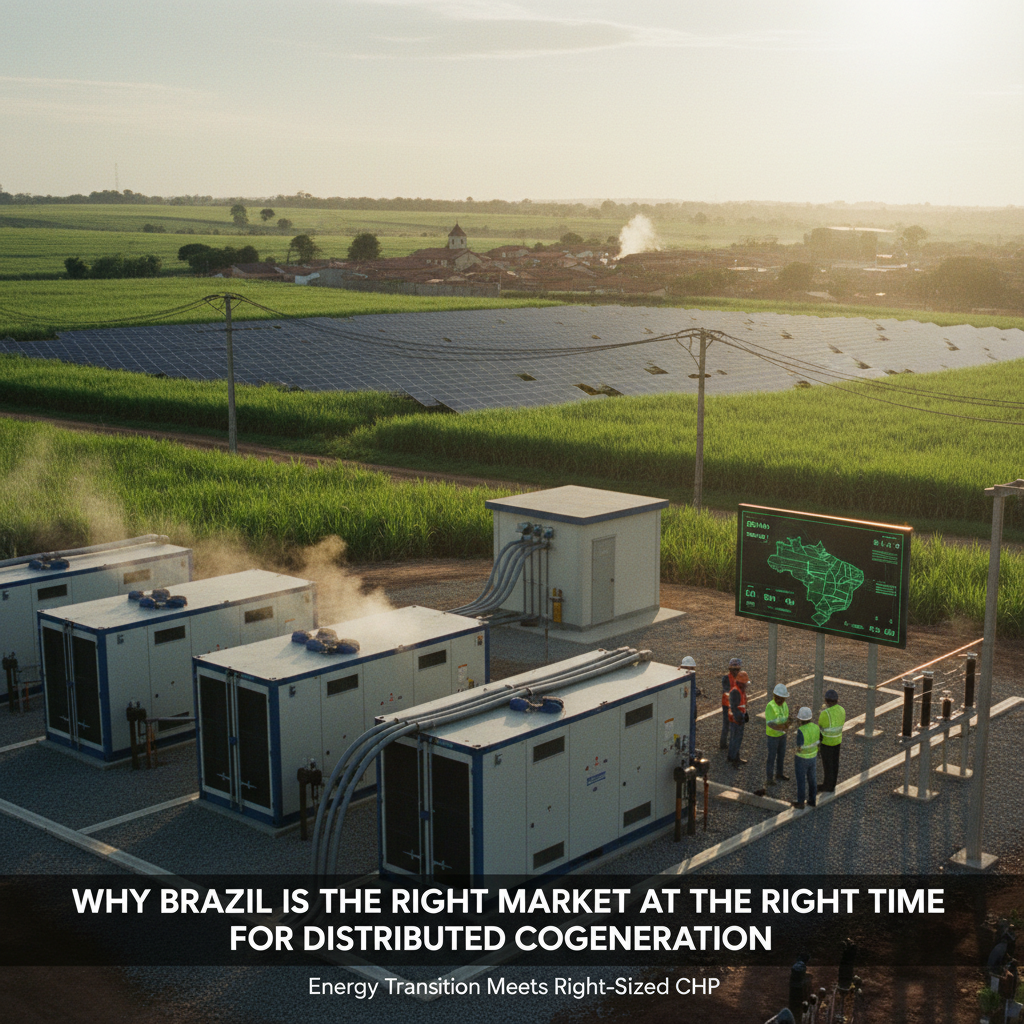
Brazil is in the middle of the most significant restructuring of its energy market in a generation — and the convergence of policy reform, feedstock abundance, and surging industrial demand has created a rare alignment that few markets ever achieve.
The Nova Lei do Gás liberalized natural-gas distribution in 2021. ANEEL's distributed generation framework now supports self-generation up to 5 MW. Ceará is building a green-hydrogen export hub at the Port of Pecém. Sugarcane mills are sitting on the largest biogas feedstock pool on Earth. And every hyperscaler from São Paulo to Fortaleza is racing to secure resilient, behind-the-meter power for the data centers they need to bring online by 2028.
What Brazil is missing is the equipment to capitalize on it — specifically, the kind of right-sized, fuel-flexible combined heat and power (CHP) that has driven Germany's distributed generation buildout for two decades. European CHP manufacturers, including the 2G Energy product line alongside comparable offerings from INNIO, MWM, and others, are precisely positioned to fill that gap. The window for first movers opens widest in the next 24 months.
Philip B. Herold writes from direct experience building and operating power businesses in Brazil.
Brazil's Biogas Feedstock Is the Largest in the World — and Almost Entirely Stranded
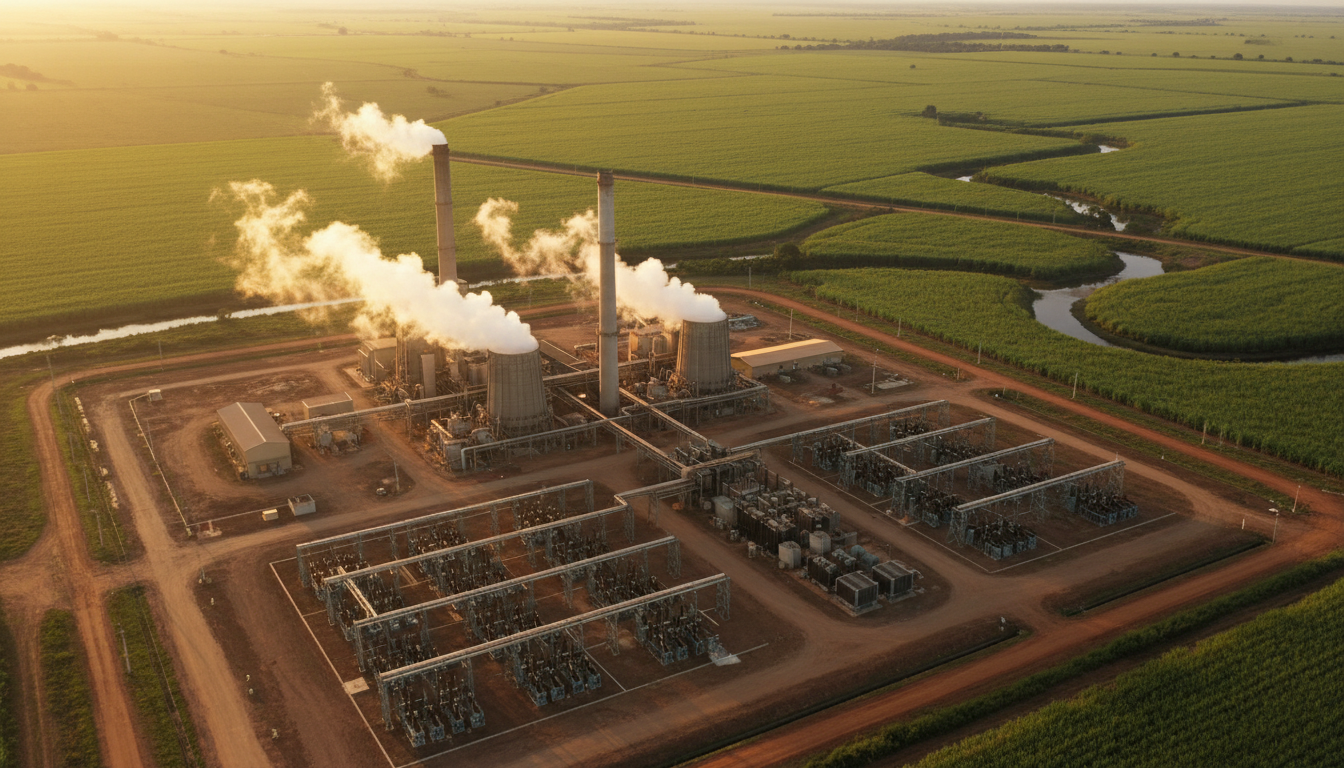
Brazil's sugarcane sector processes roughly 600 million tonnes of cane per year. The bagasse residue is partially used for boiler fuel; the vinasse residue, almost universally, is sprayed back onto fields. Both streams are excellent biogas feedstocks. Raízen, Cosan/Shell, and BP Bunge — the three largest mill operators — have publicly stated decarbonization commitments and are actively evaluating how to monetize residue streams.
Add cattle and poultry methane capture from a livestock economy second only to the United States, and Brazil's biogas potential is, by most independent estimates, large enough to displace several gigawatts of fossil generation. The technology to convert that biogas into electricity and process heat at the right scale — 500 kW to 2.5 MW per engine — is precisely the sweet spot that European CHP manufacturers have been refining for fifteen years. The mills know they need it. The supply chain, in country, doesn't yet exist at scale.
Data Center Growth Is Outpacing the Grid
São Paulo, Rio de Janeiro, and Fortaleza are the three fastest-growing data center markets in Latin America. Operators including Ascenty, Odata, and Scala are commissioning hundreds of megawatts of new capacity, and grid interconnection timelines have stretched well past what hyperscaler customers will accept.
Behind-the-meter generation is no longer a contingency play in this market — it's the default starting position. The conversation a colocation operator wants to have today is not "diesel gensets for backup" but "distributed CHP for primary or hybrid power, with diesel as the third layer." Natural-gas-fired CHP at 1 to 4 MW per unit, modular and stackable, with combined-cycle efficiency above 90 percent when the heat is used for absorption cooling — that is the technical answer the data center sector is converging on.
The Nova Lei do Gás Changed the Economics Overnight
For years, the practical barrier to gas-fired distributed generation in Brazil was not technology or demand. It was access to gas. State-controlled distribution monopolies set prices and rationed supply. The 2021 Nova Lei do Gás opened the market to competition, unbundled transport from supply, and allowed direct contracts between large consumers and producers.
In 2026, an industrial customer in São Paulo state can negotiate gas supply on commercial terms that would have been unthinkable five years ago. The result is that distributed CHP, which always made sense on thermodynamic grounds, now makes sense on the spreadsheet. The window for first movers — equipment vendors and developers alike — opens widest in the next 24 months, before the market becomes saturated with offerings.
Hydrogen-Ready Matters in Brazil Specifically
Several European engine manufacturers — including the 2G platform — have been shipping hydrogen-capable CHP units for several years. In most markets, that capability is a long-dated option: useful in the brochure, distant in practice. In Brazil, it is more concrete. The Pecém green-hydrogen hub in Ceará has signed letters of intent with multiple European offtakers. The Northeast's wind and solar resources, coupled with sub-$30/MWh PPAs, give Brazil one of the lowest projected green-hydrogen production costs in the world.
Ports, industrial parks, and remote mining operations in the H2-corridor will need on-site power that can run today on natural gas or biogas and transition to hydrogen as the supply chain matures. That is a niche very few engine manufacturers can credibly fill — and it is one of the most defensible strategic positions in the entire Brazilian distributed-generation market.
What This Means for International Equipment Makers
Brazil is not a market where you ship product from Europe and hope the channel develops. It is a market where ANEEL approvals, INMETRO certifications, BNDES financing eligibility, and ICMS treatment vary by state and require sustained in-country presence to navigate. The companies that have built durable Brazilian businesses in adjacent industrial sectors — INNIO, Caterpillar, Wärtsilä — all did so by establishing local relationships, certifying locally, and structuring deals in BRL.
The opportunity for the next wave of CHP entrants is to do the same, deliberately and faster. The technical product is differentiated. The market timing is correct. What remains is the in-country commercial execution: target accounts mapped, channel partners identified, certifications in process, and a 12-month pipeline that demonstrates what's possible.
Brazil rewards the patient. It rewards the early-but-disciplined more.
Philip B. Herold is a senior business development executive in international power generation. He led the formation of APR Energy's Brazilian subsidiary — including Business and Operating Licenses, RADAR import authorization, and ANEEL-facing regulatory relationships — and ran the $350M+ commercial execution of a 228 MW power contract in Brazil. He is bilingual in Portuguese and Spanish and based in Ponte Vedra Beach, Florida.