 Loading...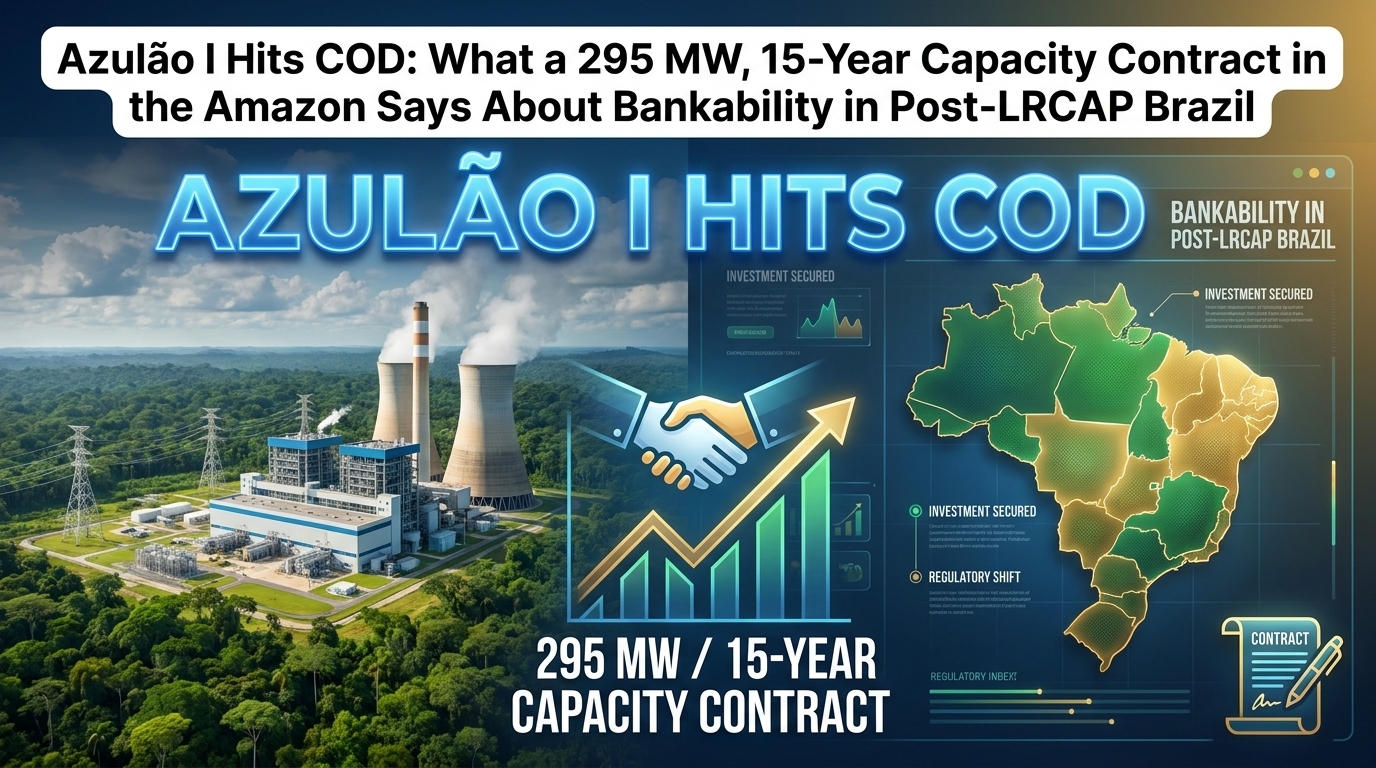
Eneva and GE Vernova declared commercial operations at the 295 MW Azulão I gas-fired thermoelectric plant in Silves, Amazonas, on 25 August 2026 — a single-site heavy-duty deployment backed by a 15-year firm-capacity contract and fed by Eneva's proprietary Azulão gas field.[1][8] For IPPs, lenders and infrastructure funds modelling the next LRCap cycle, Azulão I is not a press-release milestone. It is the cleanest live template yet of what a bankable, post-arbitrage thermoelectric project in Brazil actually looks like.
The Deal, in Concrete Terms
The plant is sited inside Brazil's Sistema Isolado — the Amazonas submarket where transmission constraints have historically made firm capacity both scarce and expensive to procure. GE Vernova supplied the heavy-duty gas turbine package; Eneva integrates the plant with its upstream Azulão field, producing a wellhead-to-busbar structure that eliminates midstream counterparty risk entirely.[8] Commercial operations were confirmed in ONS's daily dispatch bulletin for 23 August.[2]
The economic backbone is a 15-year capacity contract — a tenor that matches the LRCap architecture ANEEL homologated earlier in 2026[10] and that lenders now treat as the minimum credible amortization runway for a heavy-duty simple-cycle asset in the Norte submarket. Everything else in the capital stack — debentures incentivadas pricing, BNDES tenor negotiation, sponsor IRR — flows from that R$/MW-potência revenue line.
Why the Revenue Architecture Actually Clears Committee
Three features of the Azulão I contract structure explain why it financed where speculative peers did not:
- Capacity-payment dominance. The 15-year contract pays for availability (potência), not energy. That converts what was historically a merchant-exposed thermoelectric bet into a quasi-availability annuity — the same revenue geometry that lets regulated transmission attract sovereign capital. Dispatch upside becomes optionality, not underwriting.
- Isolated-system premium. Siting in Amazonas earns a structurally higher capacity clearing price because ONS cannot import MW from the SIN via transmission. GE Vernova's own framing — "firm power in complex transmission environments"[8] — is regulatory shorthand for a premium capacity tariff that offsets the logistics and O&M cost penalty of Amazon-basin operation.
- Fuel-supply integration. Because the fuel comes from Eneva's own Azulão reservoir, the project sidesteps the gas-supply covenant that has historically been the weakest link in Brazilian thermal financings. Lenders can size debt against a reserve-life-to-PPA-tenor ratio, not a merchant gas curve or an untested LNG regas contract — a critical distinction ahead of ANP's July 2026 LNG open-access framework taking effect.[9]
Azulão I is the first Brazilian thermal COD where all three legs of the bankability tripod — capacity-payment revenue, isolated-system pricing, and integrated fuel — are simultaneously visible on the term sheet. That is the template.
How This Fits the Post-Arbitrage Thesis
P&L Energy's May coverage of the 371 MW Wärtsilä–Origem reciprocating deal argued that "the adults in the room" were arriving in Brazilian flexible thermal.[11] Azulão I is the second executed data point on that curve — and the first with a heavy-duty gas turbine rather than recips. The contrast matters for OEM selection logic:
- Wärtsilä–Origem optimised for fast-start, high-cycling dispatch against a variable renewable-heavy grid.
- GE Vernova–Eneva optimised for high-availability, baseload-adjacent dispatch in an isolated system with captive gas.
Two very different technology answers to what is nominally the same LRCap product — evidence that OEM selection in Brazil is now being driven by site conditions and dispatch profile, not commercial-relationship inertia. EPCs pitching the 2026 auction round should read this carefully.[3]
Business & Financial Implications for Dealmakers
For IPPs and developers: Azulão I sets the observable benchmark for what a 15-year capacity contract can support in terms of leverage and equity IRR. Any 2026-vintage bid that cannot replicate at least two of the three bankability legs (capacity-payment revenue, isolated-system pricing, integrated fuel) will price at a discount — or fail habilitação outright, as the J&F/UEG denials demonstrated.[12]
For lenders and debenture underwriters: The Azulão structure is the closest thing Brazilian thermal has produced to a "regulated-like" cash-flow profile. Expect it to compress spreads on comparable debentures incentivadas issuance and to become the reference case in credit committees evaluating the next LRCap-linked financings.
For infrastructure funds: Eneva's gas-to-wire model — upstream reserves + onsite generation + long-tenor capacity contract — is now a demonstrable yield vehicle rather than a thesis slide. The hedge value against LNG price volatility is particularly relevant given the tight global gas market and Equinor's recent 2-year glut-delay signal.
For OEMs and EPCs: GE Vernova's global backlog is running above US$175 billion, with AI data-center orders alone doubling to more than US$5 billion in H1 2025.[6][9] Hot-section capacity is being absorbed by combined-cycle awards in China[5] and North American data-center builds. Brazilian developers targeting 2027–2028 COD dates need to lock turbine slots against firm PO commitments now; the LRCap 2026 timeline will not wait for a queue position that opens in 2029.
The Read-Through to the 2026 Auction
ANEEL's LRCap 2026 homologation set the pricing floor and PPA architecture for the coming US$20 billion auction cycle.[10] Azulão I coming online before that auction gives sponsors, ONS and the regulator an executed-delivery credential to point at — evidence that heavy-duty gas turbines can be commissioned into isolated systems on schedule, under a capacity-payment contract, without the arbitrage games ANEEL spent 2026 dismantling. That is exactly the credibility signal the post-arbitrage market needs going into the bid window.
The next question for the market is whether Eneva pursues an Azulão II expansion — a combined-cycle bottoming addition would materially improve heat rate and unlock incremental energy-margin revenue on top of the capacity annuity — and whether GE Vernova has a long-tenor CSA/MSA attached to the current award that lenders can factor into O&M covenants.
P&L Energy advises sponsors, lenders and OEMs on gas turbine deal structuring, LRCap bid economics, and gas-to-wire project architecture across Brazil and LatAm. Prudent business development in the post-arbitrage market requires modelling the capacity-payment stack, the fuel-supply covenant, and the OEM slot calendar together — not sequentially.
For ongoing deal intelligence on LatAm gas turbine transactions, LRCap outcomes, and OEM market moves, subscribe to the free P&L Energy newsletter.
References
- "GE Vernova, Eneva Start 295 MW Brazil Gas Plant," ESG News, 25 Aug 2026. Link
- "IPDO – Informativo Preliminar Diário da Operação 23/08/2026," ONS via CanalEnergia, 25 Aug 2026. Link
- "GE Vernova's TM2500-Powered 'Power Plant on Wheels' Supports the Bahamas Summer Rush," Turbomachinery Magazine, 25 Aug 2026. Link
- "GE Vernova's 9HA.02 Gas Turbines Power Chinese Combined-Cycle Plant," Turbomachinery Magazine, 25 Aug 2026. Link
- "GE Vernova's AI data center orders double in first half of 2025," Crypto Briefing, 25 Aug 2026. Link
- "Eneva and GE Vernova launch operations at Azulão Power Plant to deploy firm power in complex transmission environments," GE Vernova press release, 25 Aug 2026. Link
- "GE Vernova Eyes $200 Billion Backlog As AI Infrastructure Boom Drives Historic Energy Demand," Foreign Policy Journal, 23 Aug 2026. Link
- P&L Energy, "ANEEL's LRCAP 2026 Homologation," 2026. Link
- P&L Energy, "The 'Adults in the Room' Have Arrived: What the 371 MW Wärtsilä-Origem Deal Tells Us About Brazil's New Energy Reality," 13 May 2026. Link
- P&L Energy, "Brazil's Gas Midstream Just Got Its ANEEL Moment," 21 Jul 2026. Link

Leave a Comment